BL Add MS 4136 includes many papers related to Nichlas Throckmorton. Sheets after sheets are filled with numbered segments in cipher. I found many of them can be read with a key reconstructed from Add MS 35830. Although the papers from Add MS 4136 are annotated with the dates and the writer (Nicholas Throckmorton, ambassador in France, and his successors), the letters calendared in CSP foreign did not seem to quite match.
When I deciphered a sequence "marques d'Alboeuf and Martigues" in one letter, it allowed me to find the decipherment of full letters printed in Forbes (1740), the source of CSP. It confirmed that the cipher segments in Add MS 4136 are excerpts corresponding to the text in italics (i.e., those portions in cipher) in Forbes (1740).
I'm still working on this. Hopefully, I can report the results in near future.
By the way, Nicholas Throckmorton's cipher seems to have a fairly large number of code symbols. Often, a symbol consists of the initial letter of the word it represents and some additional stroke.
07/09/2023
Excerpts of Nicholas Throckmorton's Cipher Letters (1559)

06/09/2023
I Reconstructed a Cipher but Lost Its Source.
When I reconstructed a cipher from some deciphered material, I don't upload it right away, but usually wait some time until more materials are collected in order to see how best to present them.
The downside of this practice is that I sometimes forget what it is about.
The other day, I made some additions from Henry VIII's time ("Earliest English Diplomatic Ciphers" and "Ciphers during the Reign of Henry VIII"), but I lost a source of one of the ciphers I reconstructed. It may have been taken from the same volume from which I took the other ciphers.

24/08/2023
Simulated Paper-and-Pencil Codebreaking of a Ciphered Letter of Mary, Queen of Scots
Remember that I did not break this cipher myself. The article only "simulates" how it could have been achieved by codebreakers such as Thomas Phelippes without using computer tools.
13/08/2023
An English Polyalphabetic Cipher from the Seventeenth Century
12/08/2023
"Operational History of Japanese Naval Communications"
Operational History of Naval Communications: December 1941-August 1945. Japanese Monograph No.118 (Department of the Army: Office of the Chief of Military History, 1953) (pdf)
I learned of this by a citation in Chapter 17 of David Kahn, The Codebreakers. When I bought its paper reprint twenty years ago, I did not have access to the Japanese original. Now, the original (海軍作戦通信使), prepared by the Second Demobilization Bureau and dated March 1949, can be found at JACAR (Ref: C19010076600).
An edition by the Service School of the Safety Security Force (警備隊術科学校), dated 1953, is also available in pdf on Akio Tsutsumi's website (
 ).
11/08/2023
(Nonsecret-)Coded Military Telegram of Imperial Japanese Army (1936)
I added its transcription in an article in Japanese. (The abridged version in English, "Japanese Telegraph Codes", has not been updated recently. I hope machine translation will help reading the Japanese article.)
04/08/2023
A Cipher Letter to Henry VII from John Stile
Although the letter is known in calendared text, the printed text is much shorter than the plaintext deciphered from the cipher letter.
01/08/2023
Ciphers of John Stile and Thomas Spinelly (1510s)
Stile's cipher turned out to be the one used in an undeciphered ciphertext I found in the Spanish archives (which was deciphered in the nineteenth century!). The condensed writing is so characteristic that the moment I saw Stile's cipher letter, I was sure it is the cipher used in the letter that I thought was Spanish. The record is now updated in "Unsolved Historical Ciphers".
31/07/2023
A Cipher of Catherine de Medicis' Agent
I also made some additions in "Ciphers during the Reign of Queen Elizabeth I" from Cotton MS Caligula B VIII.
21/07/2023
American Peace Commissioners' Instructions Coded for Franklin
I uploaded a new article about this: "American Peace Commissioners' Instructions in John Jay's Book Code".
18/07/2023
Some Links to Papers of Continental Congress (PCC)
Since it may take time to overhaul the links, here are my log of comments to PCC. It seems the links are valid only when you are signed in.
https://www.fold3.com/image/4220962/vol-5-vol-5-page-251-continental-congress-papers
Item No.104
Item Title Ltrs from John Adams
Roll 131, p.251
John Adams to John Jay, 2 June 1785
Transcript of the letter in code on Page 469 of Roll 113. The plaintext is on Page 258 of the present roll (Roll 131).
https://www.fold3.com/image/441663/volume-1-page-561-continental-congress-papers
Item No 168
Roll 185 p.561
Coded in WE003 (as classified by Ralph E. Weber)
https://www.fold3.com/image/451493/volume-1-page-21-continental-congress-papers
Item No. 83
Item Title Letters from Arthur Lee, 1776-80
Arthur Lee to Secret Correspondence Committee, 3 June 1776
Printed in Wharton http://memory.loc.gov/cgi-bin/query/r?ammem/hlaw:@field(DOCID+@lit(dc00230)) According to its note, at the end of this letter is a minute explanation of a cipher. It is WE085 as classified by Ralph E. Weber.
https://www.fold3.com/image/397487/volume-1-page-50-continental-congress-papers
Item No. 110
Item Title Ltrs from John Jay
Roll 135 p.50
John Cadiz to Pres. of Cong. 3 March 1780
Book code based on Entick's New Spelling Dictionary is used. For details, see http://cryptiana.web.fc2.com/code/bookcode.htm
https://www.fold3.com/image/399035/volume-1-page-309-continental-congress-papers
Item No. 110
Item Tittle Ltrs from John Jay
Roll 135, p.309
Book code based on Abel Boyer's French Dictionary.
The count replied 509c23[that] 269c14[his] 336b27[maimed?] 557a24[would]
363a19[never] 118b17[consent] to 336c13[majorship?] that 520a36[tremendous?] 510a40 44b13 371a12 373a22 551c7
269b30 24a18 the United States that 509c23 520a36 had been
115a33 79b17 the 227c12 555a11 510a40 313a21 371a12 the King and 555a11
261a11 g 335b20 269b30 510a40 371c25 371a12 being a 386a11 514c13 307a29
...
https://www.fold3.com/image/428699/volume-1-page-51-continental-congress-papers
https://www.fold3.com/image/428701/volume-1-page-52-continental-congress-papers
Item No. 88
Item Title Ltrs from William Carmichael
Roll 116, p.51,52
Book code based on Entick's New Spelling Dictionary is used.
https://www.fold3.com/image/425170/volume-1-page-417-continental-congress-papers
Item No. 79
Item Title Ltrs of Secy of Foreign Aff Livingston
Roll 105, p.417
9 May 1782
Livingston expresses his surprise that Jay could not decipher his letter.
https://www.fold3.com/image/425187/volume-1-page-427-continental-congress-papers
Item No. 79
Item Title Ltrs of Secy of Foreign Aff Livingston
Roll 105, p.427
to Mr. Adams, who will take means to forward it to you by a safe hand. I am in great pain on account of your / letter of the 28th of July, a duplicate of which is arrived. The / original has miscarried. Should it have fallen into improper / hand it may do us very essential injury. I need not tell you / how impatient I shall be to hear that this has reached you, since I / can not use my cypher till I receive a line from you written in it, nor can I write with freedom to you till I have a cypher.
station. As you will have much leisure on hand, I must beg / you to write weekly to this office in cypher and to write with / freedom whatever it may be useful for us to know, particularly / all changes that may take place in the administration and / the measures of Russia. I will not repeat what I have said / on this subject in my last, a quadruplicate of which is / enclosed, as is also a cypher. This letter will be consigned /
https://www.fold3.com/image/425010/volume-1-page-334-continental-congress-papers
Item No. 79
Item Title Ltrs of Secy of Foreign Aff Livingston
Roll 105, p.334
13 December 1781
Code WE007 (as classified by Ralph E. Weber) is used.
https://www.fold3.com/image/419076/july-16-1783-nov-30-1785-vol-5-page-518-continental-congress-papers
Item No. 84
Item Title Ltrs from John Adams
Roll 113, p.518
20 June 1785
Adams-Jefferson code (THE=994) is used. See http://cryptiana.web.fc2.com/code/jeffersn.htm
https://www.fold3.com/image/256963/volume-1-vol-1-page-5-continental-congress-papers
Item No. 87
Item Title Ltrs from Thomas Jefferson
Roll 115, p.5
11 May 1785
Jefferson to Jay
Jefferson sent Jay a code (THE=224; see http://cryptiana.web.fc2.com/code/jeffersn.htm). Its use can be found on Roll 115, Page 47, Page 438, and Page 504.
https://www.fold3.com/image/407600/1775-1781-vol-1-page-705-continental-congress-papers
Item No. 51
Item Title Intercepted Letters - British
Roll 65, p.705
23 July 1781
James H. Craig to Lord Cornwallis
The cipher is a simple substition of the 25 letters of the alphabet by numbers 10-39. For details, see http://cryptiana.web.fc2.com/code/cornwals.htm
https://www.fold3.com/image/407130/1775-1781-vol-1-page-529-continental-congress-papers
Item No. 51
Item Title Intercepted Letters - British
Roll 65, p.529
7 October 1780
Cornwallis to James Wemyss
The cipher is a simple substition of the 25 letters of the alphabet by numbers 1-29. In higher numbers, only the right-side digit is valid. For details, see http://cryptiana.web.fc2.com/code/cornwals.htm
https://www.fold3.com/image/400467/volume-2-page-77-continental-congress-papers
Item No. 110
Item Title Ltrs from John Jay
Roll 135, p.77
The cipher passage is coded with WE006. The translation is printed in Wharton.
https://www.fold3.com/image/399111/volume-3-page-19-continental-congress-papers
Item No. 102
Item Title Ltrs from US to France
Roll 128, p.19
27 April 1779
Arthur Lee to John Bondfield
I send you a cypher by which we may corres- / pond without risque. I have seen enough of particular per- / sons to know not there is more danger to our country / from them than from the British army. The Chevalier
https://www.fold3.com/image/259572/volume-1-1776-84-vol-1-page-44-continental-congress-papers
Item No. 93
Item Title Ltrs from Charles WF Dumas
Roll 121, p.44
30 June 1776
Dumas to unknown
A letter in part in Dumas' cipher (see Roll 72, Vol. 1, Page 117). One portion reads: 613 [h] 2 [o] 17 [r] 15 [t] 19 [a] 4 [l] 5 [e] 414 [z] 207 [,] 424 [h] 69 [a] 1 [v] 16 [i] 14 [n] 104 [g] 11 [s] 9 [o] 76 [m] 13 [e] 33 [t] 613 [h] 21 [i] 27 [n] 238 [g] 34 [t] 50 [o] 51 [n] 24 [e] 476 [g] 67 [o] 52 [t] 53 [i] 75 [a] 57 [t] 26 [e] 22 [f] 94 [o] 25 [r] 61 [t] 424 [h] 29 [e] 28 [c] 9 [o] 54 [n] 561 [g] 46 [r] 32 [e] 12 [s] 39 [s] 226 [z] (Hortalez, having something to negotiate for the Congress)
https://www.fold3.com/image/379527/apr-30-1781-apr-29-1783-vol-2-page-206-continental-congress-papers
Item No. 101
Item Title Ltrs to Dumas from Franklin and others
Roll 127, p.206
A letter dated August 16, 1781, from Franklin to Dumas (not found in Wharton). The cipher is Dumas' cipher (see Roll 72, Page 117). The paragraph in cipher reads as follows: I have just received a neuu comi- issjon joining me uuit h M adams in ne- gociaions fo- r peace but this is not likely to afford me much em- pley at prese- nt
https://www.fold3.com/image/379444/jan-27-1780-apr-19-1781-vol-1-page-126-continental-congress-papers
Item No. 101
Item Title Ltrs to Dumas from Franklin and others
Roll 127, p.126
3 December 1780
Two phrases are in cipher and left blank in Wharton (see http://memory.loc.gov/cgi-bin/query/r?ammem/hlaw:@field(DOCID+@lit(dc004122)) for an electronic text). Ralph E. Weber (United States Diplomatic Cods and Ciphers, p.78, WE004) decoded them. The first one 873 373 657y reads "The Great Pention-y", that is, The Grand Pensionary. In the second instance, Wharton omits a whole sentence: "I remember of but one, which went with a copy of 873 897y 948 337." The cipher reads "The Treat-y with France".
17/07/2023
Two More Enciphered Letters of Mary, Queen of Scots
I identified the keys used in these letters from among the keys I reconstructed.
One is the Mary-Hamilton Cipher. Thus, the recipient is probably John Hamilton, Archbishop of St. Andrews.
The other is the Mary-Norfolk Cipher. (Right after uploading this update, I found the deciphered text, with normalized spelling, is printed in Labanoff.)
These updates are now in "Ciphers of Mary, Queen of Scots".
10/07/2023
Agostino Amadi's Treatise on Cipher
I thank DPJA Scheers for drawing my attention to this topic.
01/07/2023
Galileo's Anagrams and Gergo (Jargon)
Apart from gergo, the paper also discusses the famous anagrams Galileo composed to claim his astronomical discovery without disclosing the content. Interestingly, Johannes Kepler came up with his solutions, which were wrong, but are interesting because they are as if Keplar coincidentally predicted the moons of Mars and the Great Red Spot of Jupiter. These are covered by a new article, "Anagram and Gergo (Jargon): Galileo's Secret Communication".
29/06/2023
Prince of Conti's Keyphrase Cipher
Since the keyphrase cipher is usually polyphonic, his paper is also interesting as a demonstration of solving a polyphonic cipher.
Now, I added a reference to this in "A Polyphonic Substitution Cipher of the Catholic League (1592-1593)", where I'm collecting specimens of polyphonic ciphers.
25/06/2023
Ciphers during the Reign of Henry VIII
18/06/2023
Concealment Cipher on "Ramune" Soda Candy Package
For a change, it's about a lighter topic today.
When I sat at the dining table the other day, I noticed a strange text on a package of "Ramune" soda candies (Morinaga), which read something like "It may be just me, but I'm too hungry that the area of a triangle somehow looks like nothing but a cake." The incoherent message seemed so out of place on a candy package. My son told me the real message appears when we pick up only characters in bluish color. It is supposed to be used with a red transparent sheet that students use to memorize stuff (Wikipedia (in Japanese)).
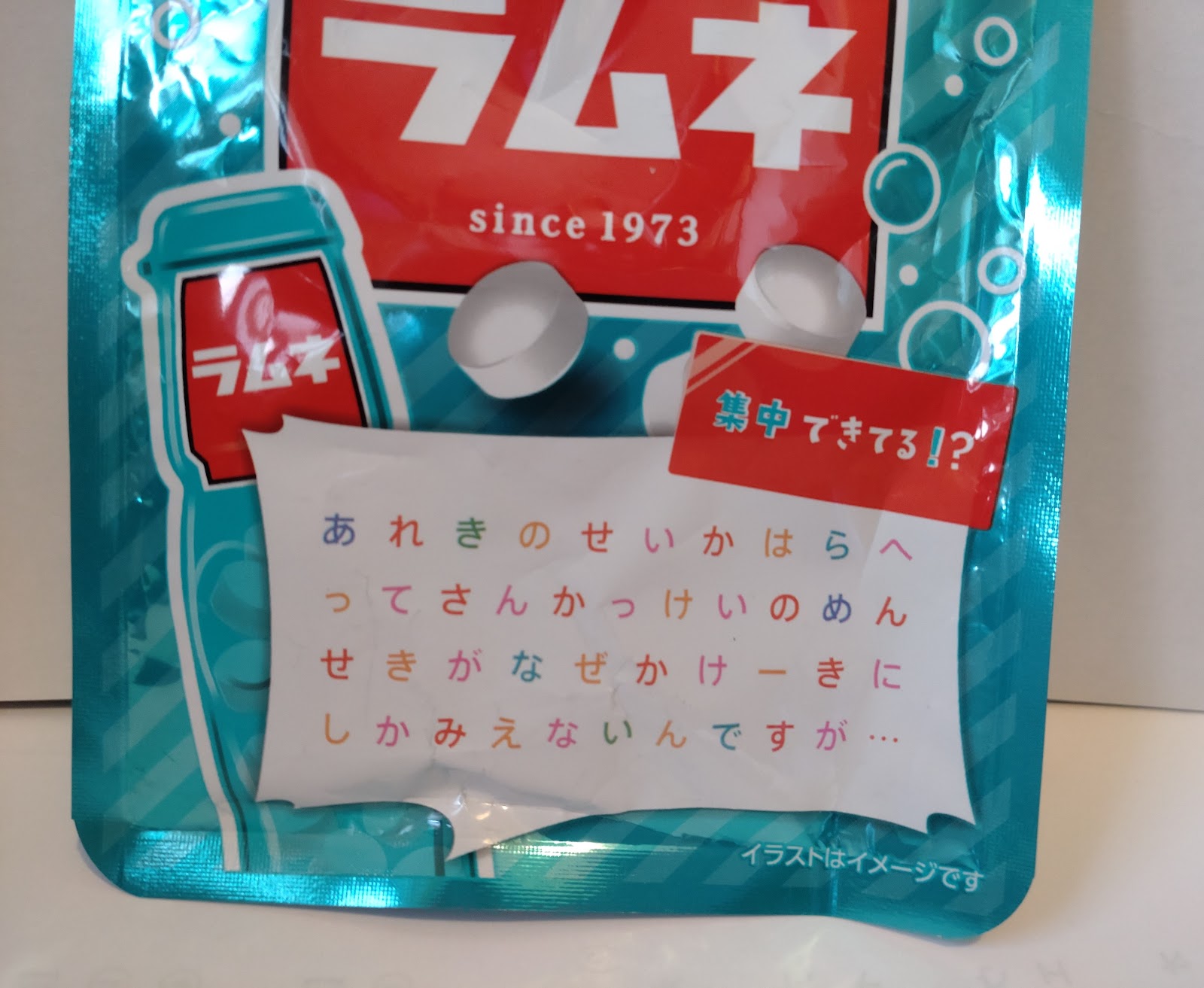
Application of the sheet reveals the message "Don't give up."

Package says this is a special version with 10%-increased content for students studying for their entrance examination. Another version reveals a message "You can do it."

17/06/2023
Spanish Ciphers with Vowel Indicators Solved
Now, Carlos sent in his solution of another vowel indicator system used in a letter from Juan de Idiaquez Olazabal y Pedro Gonzalez de Mendoza to Philip II. As it turned out, the cipher is the same as a cipher used in other channels.
Now, the achievement is recorded in "Spanish Ciphers during the Reign of Philip II" and "Unsolved Historical Ciphers".
13/06/2023
George Lasry's Breakthrough into Syllabary Ciphers
George has solved many ciphers from my list (and of course other cipher challenges), including the batch presented in Decipherment of Hitherto Unsolved Historical Ciphers (by George Lasry). But this time, the achievement is more than just another cipher solved. Most ciphers broken up to now are homophonic substitution ciphers, in which a letter of the alphabet may be represented by one of multiple candidate symbols (homophones). In the last decade, solution of such homophonic ciphers by computer algorithms became a standard technique, and homophonic solvers are now readily found on the web. The technique is described in, e.g., Nils Kopal (2019), "Cryptanalysis of Homophonic Substitution Ciphers Using Simulated Annealing with Fixed Temperature" (which I mentioned here, and which seems to be still the state of the art, as attested by the citation in George's recent pulication for HistoCrypt 2023). As long as a major part of the ciphertext consists of symbols for individual letters, today's homophonic solvers would readily provide a solution (or at least give a breakthrough).
But codebreaking algorithms up to now have not been able to successfully solve ciphers when the ciphertext includes many symbols representing syllables, names, and other words. For the Brasset-Mazarin cipher, I had a brief email exchange with George back in 2021, but at that time, even his calibre couldn't break the cipher. There has been a widely shared desire for a solver algorithm for such ciphers including syllables.
It seems George has now developed a workable algorithm for handling such syllable ciphers, because he also solved several other syllable ciphers including two from the Spanish archives (Simancas, EST,LEG,1381,143 and 180, see here).
Solution of syllable ciphers does not merely involve larger search space than for letter-based ciphers. It would require some radical change in the scoring function, i.e., a measure of how plausible the plaintext obtained by a provisional key is. For letter-based ciphers, a syllable structure might give a measure of goodness. But when many symbols correspond to syllables, the provisional plaintext would include many plausible syllables, even if the assignment is random.
I hope George will publish some paper for this groundbreaking work in the history of cryptanalysis.
04/06/2023
Castiglione-Schomberg Cipher: Vowel Indicator System (1527) Earlier Than Those Hitherto Known
The cipher, which I call the Castiglione-Schomberg Cipher, is used in letters deciphered by Marcello Simonetta and Norbert Biermann.
The cipher employs a scheme I call a vowel indicator system, whereby syllables are represented by a base symbol indicative of a consonat combined with an additional stroke or a superscript figure indicative of a vowel.
Castiglione was an apostolic nunctio (ambassador) sent by the Pope to Emperor Charles V in Spain, and Schomberg worked for the Pope in negotiation with the Imperialists. It is desired to establish whether this cipher was provided by the Vatican, because some of the other early vowel indicator systems appear to belong to the Imperialists. If the Castiglione-Schomberg Cipher was Vatican's, a new question arises how come the same scheme began to be used by both the Vatican and the Imperialists about the same time. I included some preliminary discussion on the matter.
I also mentioned this in "Tracing the Origin of Vowel Indicators in Spanish Ciphers".